Sugar, semolina and pistachio — mapped by region, explained by technique.
01Geography
Syrian sweets are not one tradition. They are a set of regional
specialities that grew out of what each city could grow, mill, or trade
for — and the differences are still visible in the pastry shops.
Outline from Natural Earth 1:10m data, projected equirectangularly with
latitude correction. Select a city to filter the sweets below; select it
again to clear.
Showing all sweets.
Aleppo — the pastry city
Aleppo's reputation rests on pastry rather than on syrup. The city's
confectioners are known for layered filo work, for nut-packed baklava, and
for the shortbreads that go with coffee. A 13th-century cookbook compiled
in Aleppo, the Kitab al-Wuslah ila l-habib, is one of the
earliest written records of the region's kitchen, and the city's sweet
shops still work in the same idiom: thin dough, clarified butter, and
pistachio.
Damascus — sesame and syrup
Damascus is the city of the sesame cookie and the cheese pastry. Barazek
is generally traced to the Ottoman period and specifically to the
Al-Midan quarter of Damascus, where the trade of the barāziqī —
the barazek seller — was recorded as a distinct profession. Kanafeh has a
Damascus origin story too: one tradition places its invention at the
Umayyad court, made for the caliph Mu'awiya I.
Homs — the simple sweets
Homs has its own repertoire, less exported than Aleppo's and less written
about. Syrian state media and Arabic-language press describe a family of
Homs sweets — bashmina, qarmashliyya, balatat
jahannam, and simsimiyya — whose appeal is explicitly
described as lying in their simplicity. These are sesame- and
semolina-based confections, closer to a biscuit than to a pastry.
Hama and the countryside
Hama and the surrounding agricultural belt supply much of the raw
material: wheat and semolina from the plains, pistachios from the
orchards around Hama and Aleppo, and sesame grown across the north. The
sweets of the smaller towns tend to be the ones that keep — maamoul
pressed in wooden moulds, halva in blocks, sesame biscuits — because they
were made to be carried.
A note on sourcing. The regional attributions here follow
the standard reference literature and the Arabic-language press cited in
the credits. Where a sweet is claimed by more than one city — kanafeh is
the obvious case — the page says so rather than picking a winner.
02The sweets
Thirteen confections, grouped by what holds them together: semolina,
filo, spun pastry, cheese dough, or nothing but sugar and sesame.
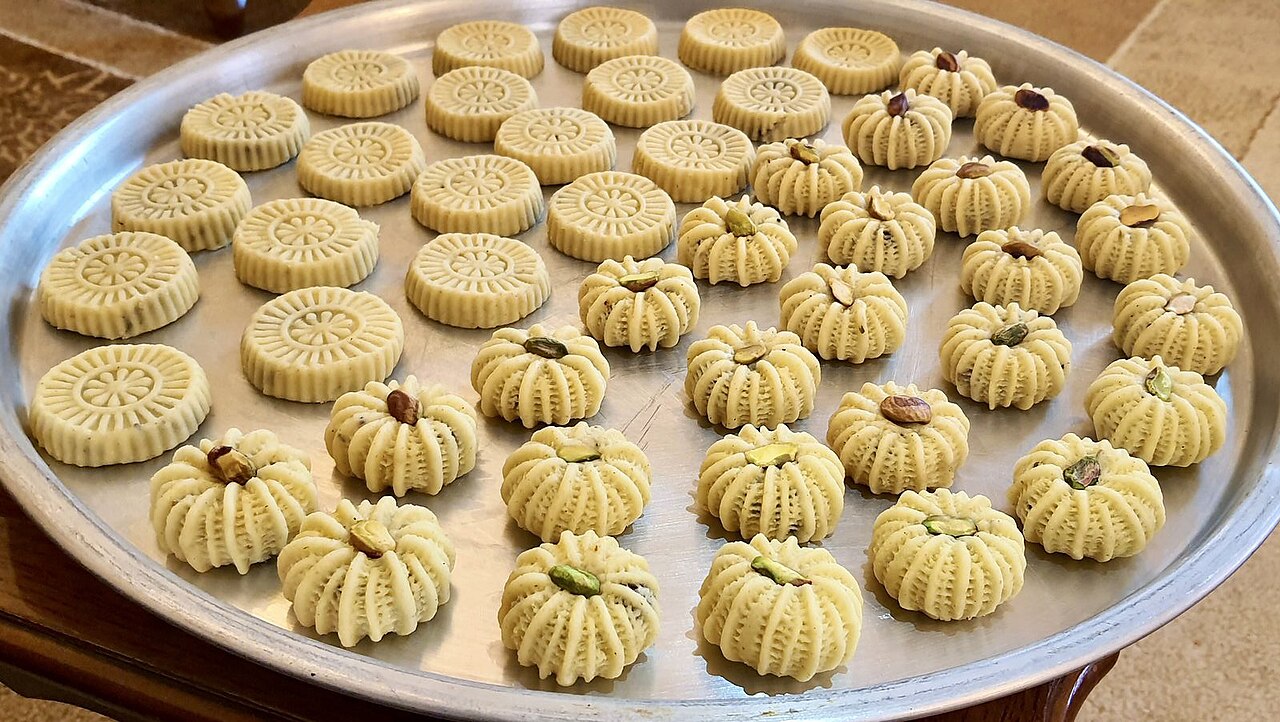
Maamoul in traditional moulds. Photo: روتانا, CC BY 4.0.
Maamoul
معمول
A filled cookie of semolina and butter, pressed into a wooden mould
called a tabe that stamps a pattern into the top. The pattern
is not decoration alone — different moulds denote different fillings,
so a buyer can tell dates from walnuts by shape.
The dough is mixed and then left to rest so the semolina absorbs the
butter before the filling goes in. Fillings run to dates, figs,
pistachios, walnuts, and occasionally cheese. Food historians link the
Levantine maamoul to kleicha, a Mesopotamian date cookie, and
to the Egyptian kahk. An 1895 Arabic-English dictionary
already glossed maʿmūl as "a kind of Syrian cake".
BaseSemolina, butter
FillingDates, figs, pistachio, walnut
MethodMoulded, then baked
OccasionEid and Easter
WhereAleppo, Damascus, Hama — pressed in wooden moulds across the Levant
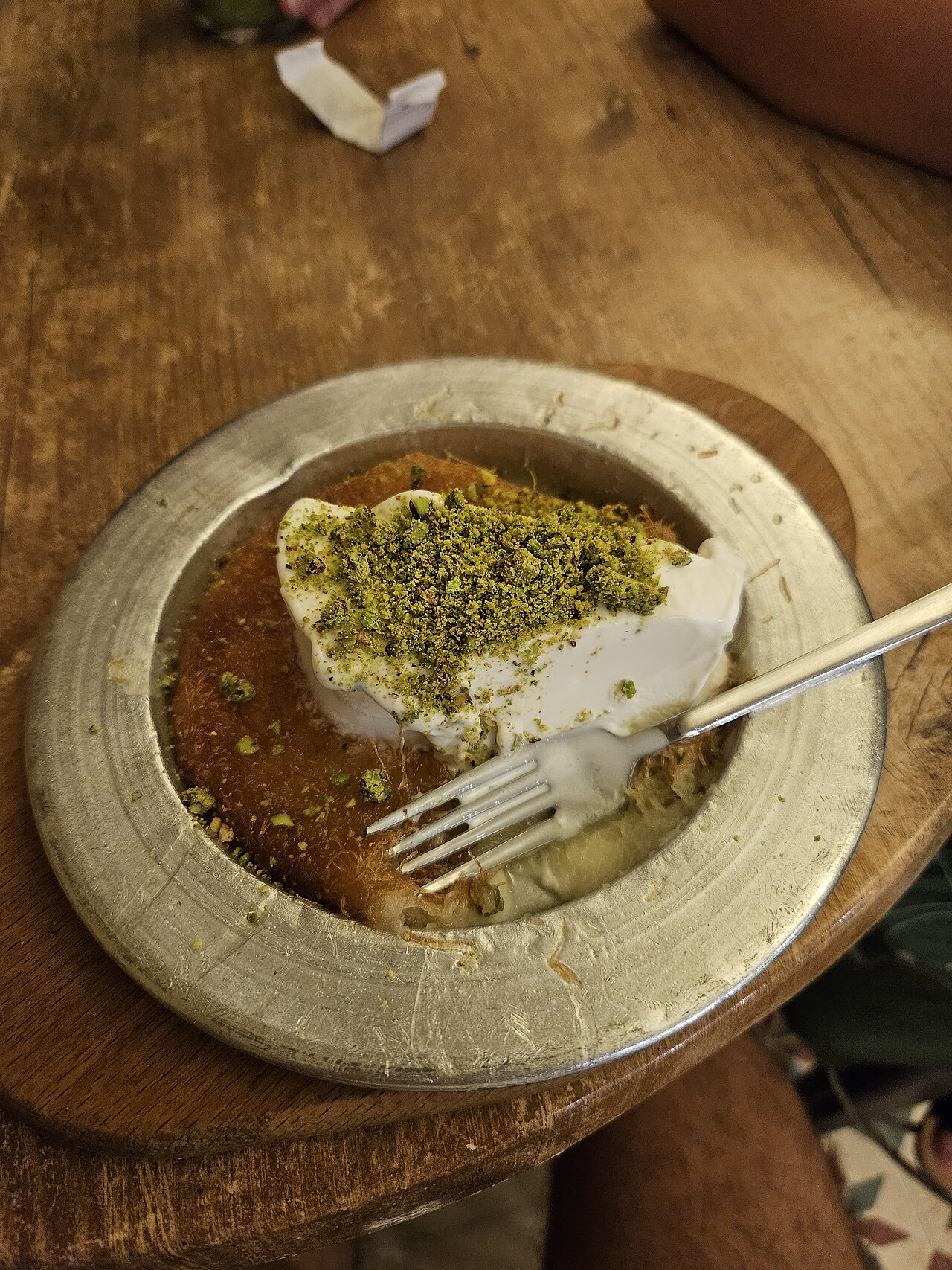
Kanafeh with kaymak and pistachio. Photo: Theipu, CC0.
Kanafeh
كنافة
Spun pastry — kadayif — layered with soft cheese and soaked
in a sugar syrup called attar. Served hot, usually with more
syrup poured at the table and a dusting of pistachio on top.
The name has a contested etymology: possibly Coptic, possibly from an
Arabic root meaning "to flank or enclose". The origin story is equally
contested — one version places it in Fatimid Egypt, another at the
Umayyad court in Damascus. The most famous regional variant,
kanafeh nabulsiyeh, comes from Nablus in Palestine and uses a
firm, stretchy cheese.
BaseKadayif, cheese
SyrupAttar
MethodBaked or fried, then soaked
OccasionRamadan, celebrations
WhereDamascus (Umayyad origin story); Nablus for the nabulsiyeh variant
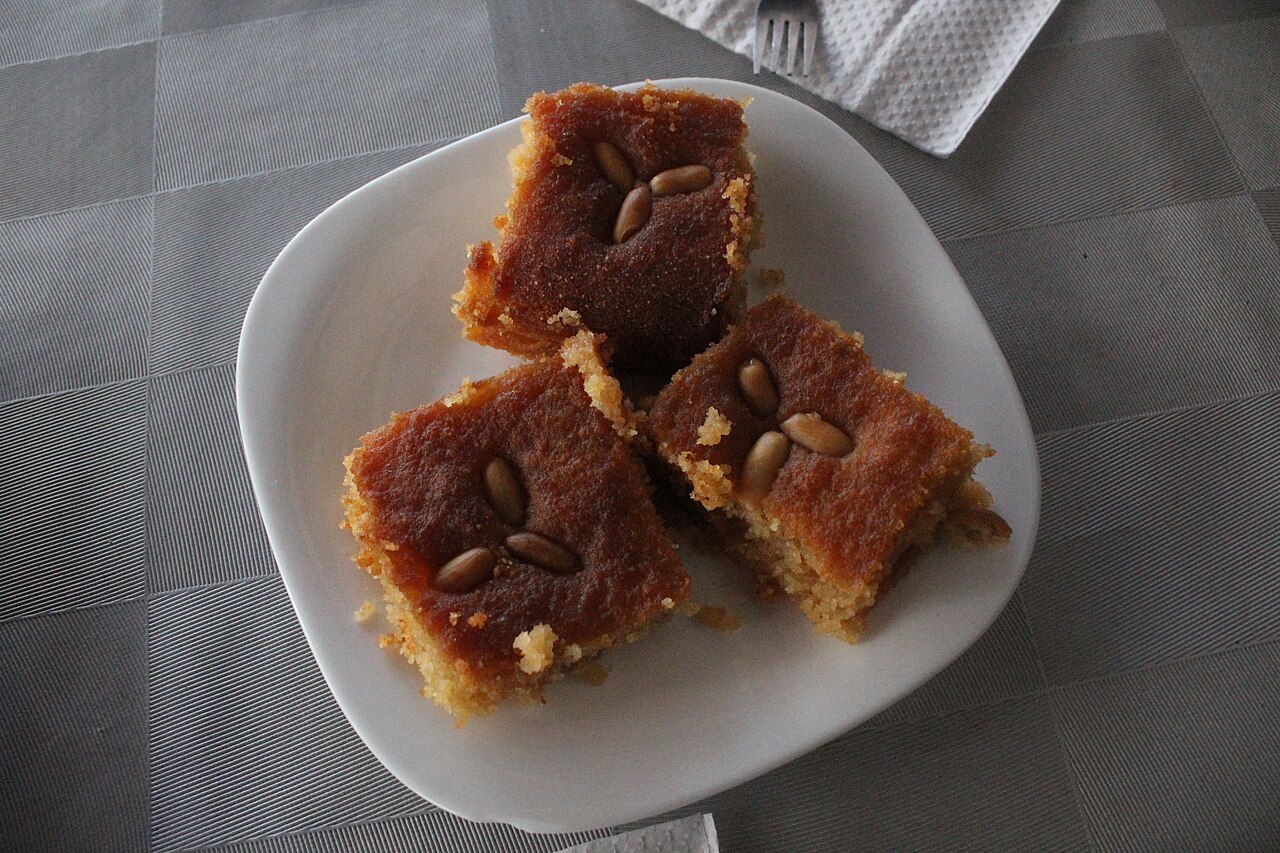
Basbousa, cut into squares. Photo: Sami Mlouhi, CC BY-SA 4.0.
Basbousa
بسبوسة
A semolina batter baked in a sheet pan, soaked in sugar syrup, and cut
into diamonds or squares. Known as harisa, nammoura,
or revani depending on where you are standing.
The Oxford Companion to Food traces it to ma'mounia,
a 9th-century Abbasid dish of rice cooked in fat and syrup, later
adapted to semolina. Ottoman revani was a frothier, egg-rich
cousin; street sellers used semolina and fewer eggs, which is closer to
the Syrian version.
BaseSemolina, yogurt, butter
SyrupSugar, lemon, rose water
MethodBaked, then soaked
FinishAlmond or pine nut
WhereHoms and Hama; the Syrian name is harisa
Ghraybeh with pistachio. Photo: Alborz Fallah, CC BY-SA 3.0.
Ghraybeh
غريبة
A shortbread that melts rather than crunches, usually made with ground
almonds and clarified butter. The texture comes from the fat-to-flour
ratio, not from leavening — there is none.
Versions exist across the Arab world, the Balkans, and the former
Ottoman lands, and it is a close relative of the Andalusian
polvorón. An 1889 congress of Orientalists described Syrian
ghraybe as a kind of maamoul shaped into small rings or
hexagonal stars, with no nut filling and a high butter content.
BaseFlour, samneh, sugar
FlavourAlmond, pistachio, rose water
MethodShaped, baked low
ServedWith coffee or tea
WhereAleppo — the shortbread that accompanies coffee
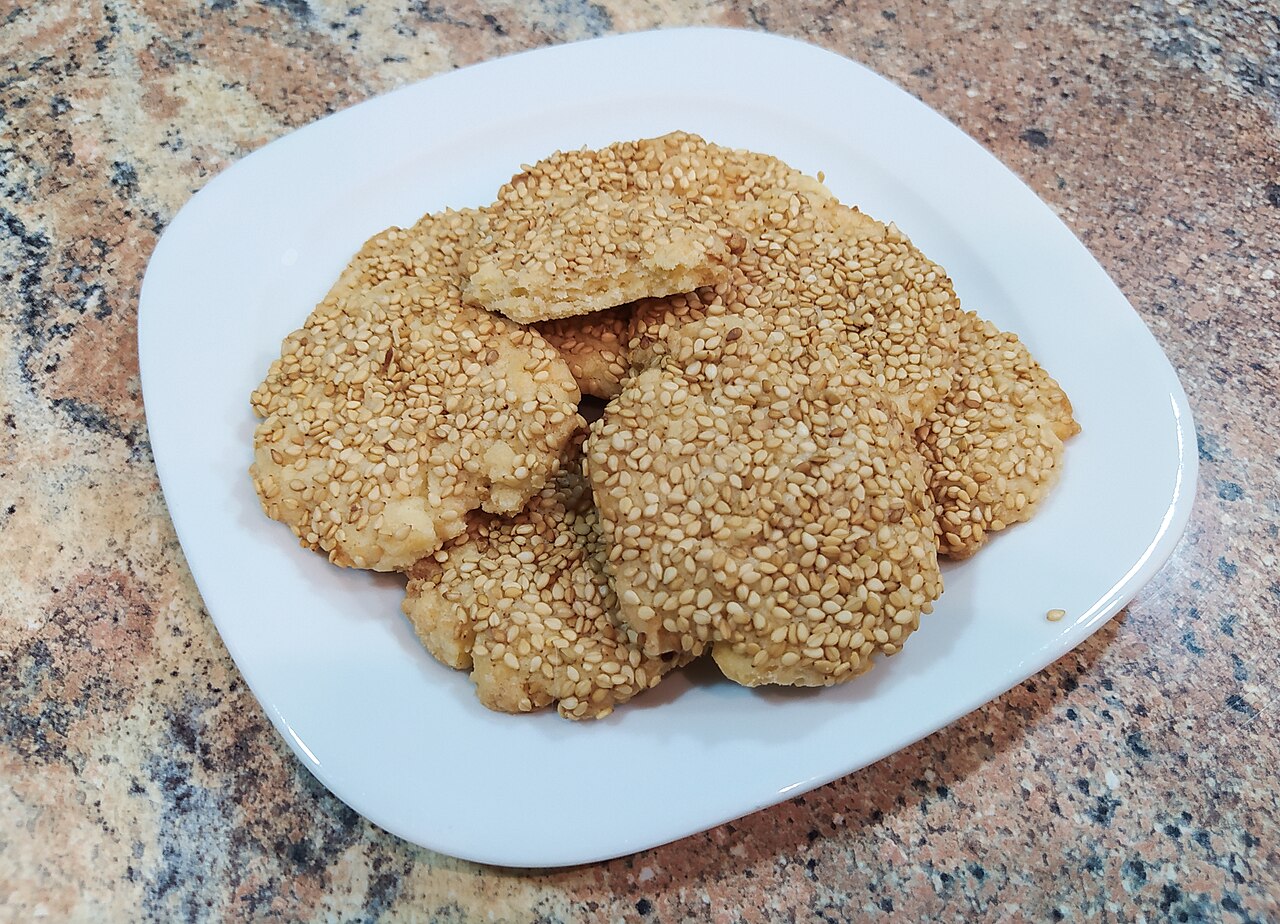
Barazek, sesame side up. Photo: El Mono Español, CC BY-SA 4.0.
Barazek
برازق
A thin, crisp cookie whose defining feature is a dense coating of
sesame on one face, often with pistachio in the dough. Sweetened with
sugar or dibs — fruit syrup — and sometimes finished with
qatir.
It is generally traced to Ottoman-era Damascus and specifically to the
Al-Midan neighbourhood. The trade was formal enough to have its own
name: the barāziqī, the barazek seller, appears as a
profession in Zafir al-Qasimi's Dictionary of Damascene
Industries, which notes that sales peaked during Ramadan and that
cheaper versions used sesame oil instead of butter.
BaseFlour, butter, sesame
SweetenerSugar or dibs
MethodRolled, seeded, baked
OriginDamascus, Al-Midan
WhereDamascus, specifically the Al-Midan quarter
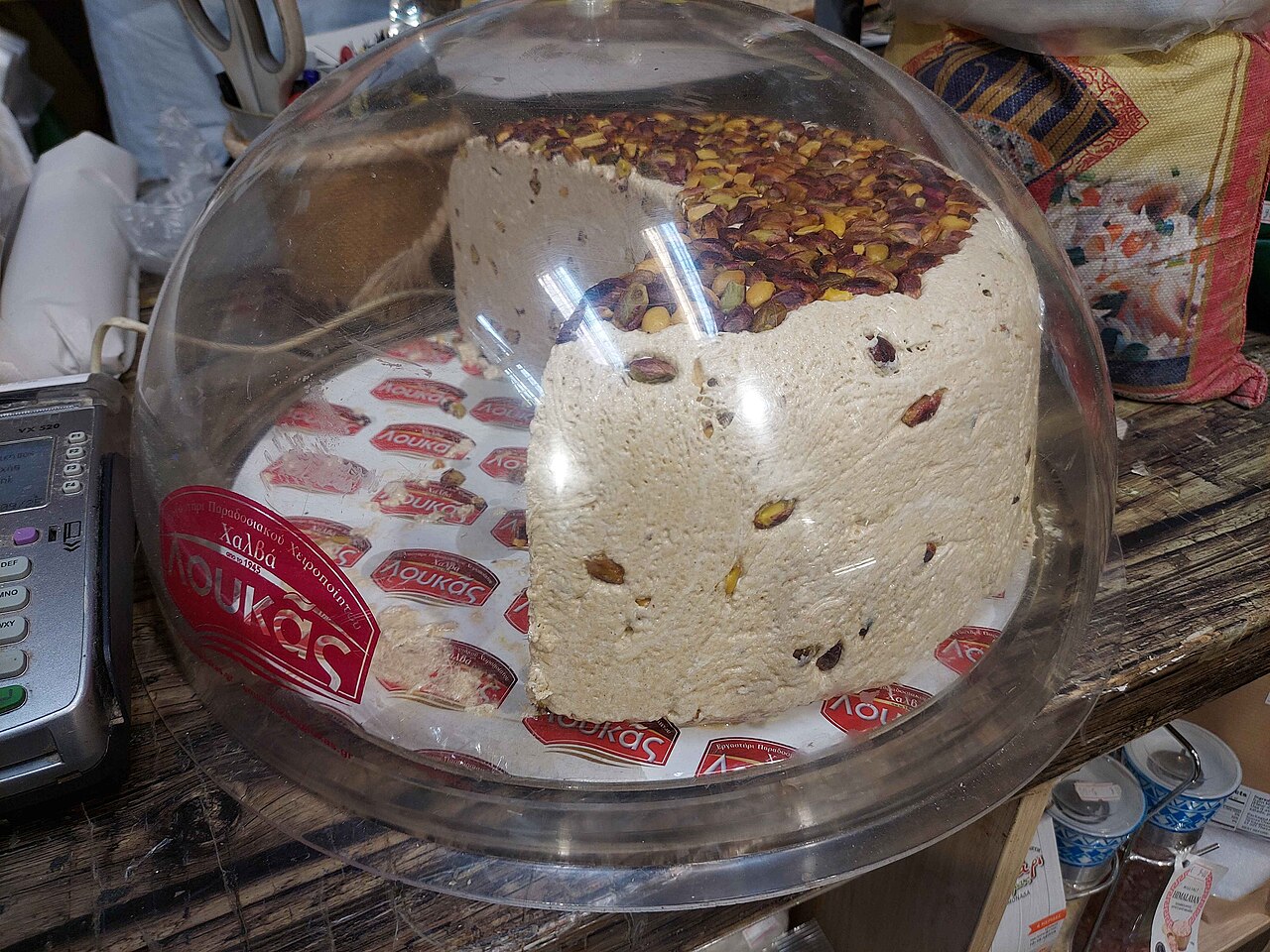
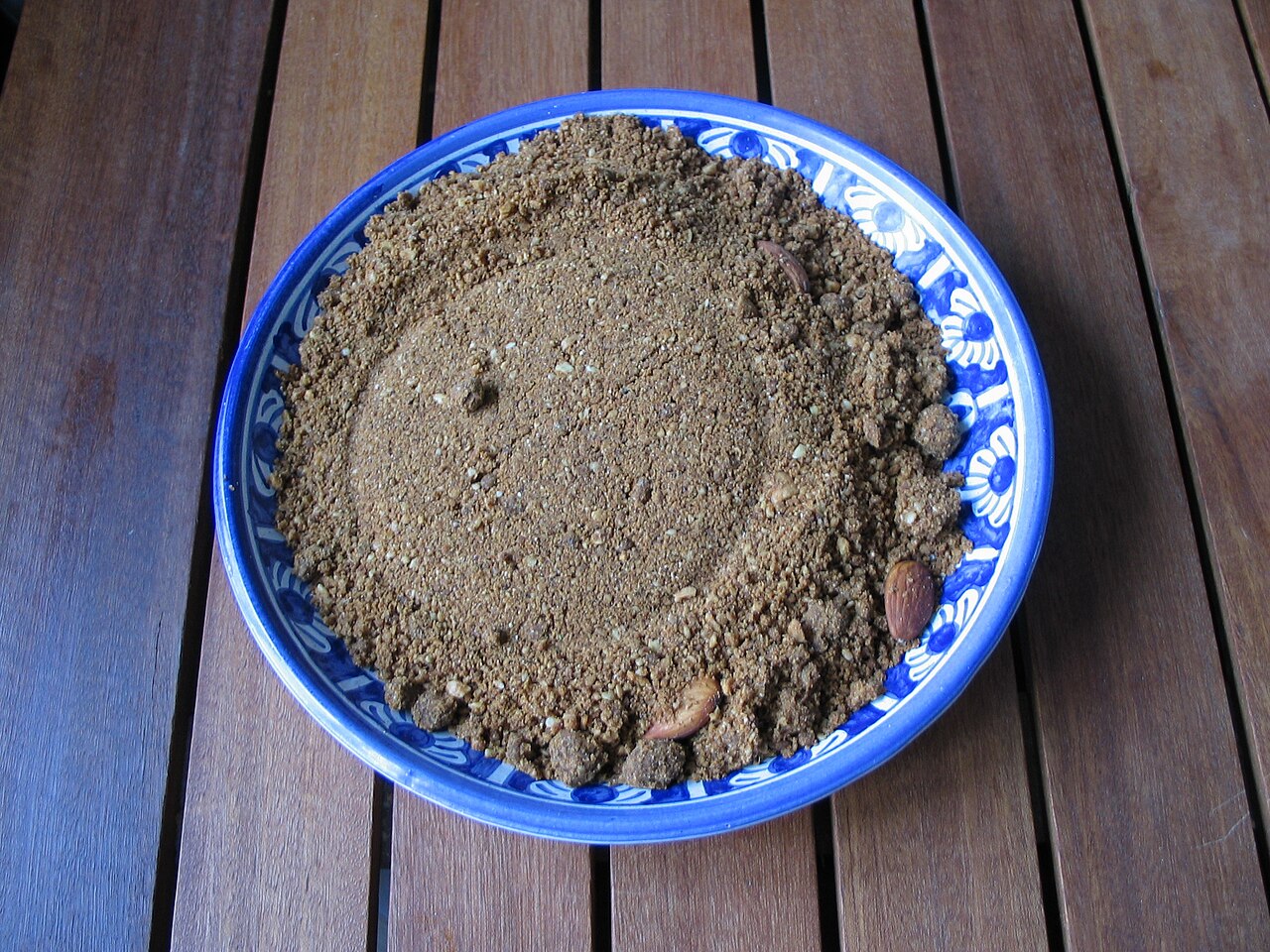
Tahini halva with pistachio. Photo: Drejwen, CC BY 4.0.
Halva
حلاوة
A broad family rather than a single recipe. The Syrian and Levantine
version is usually sesame-based — ground tahini folded into hot sugar
syrup — which gives a dry, crumbly, faintly bitter confection quite
unlike the gelatinous semolina halva of Iran and Turkey.
The word descends from Arabic ḥalwā, from a root meaning
"sweet". The confection itself is older than the name: Athenaeus
describes a Greek sesamidios, a ball of honey, roasted sesame
and oil, which is recognisably the same idea.
BaseTahini, sugar
TextureDry, crumbly
MethodSyrup folded into tahini
FinishPistachio, sometimes chocolate
WhereAleppo and Homs; sesame halva is the Levantine form
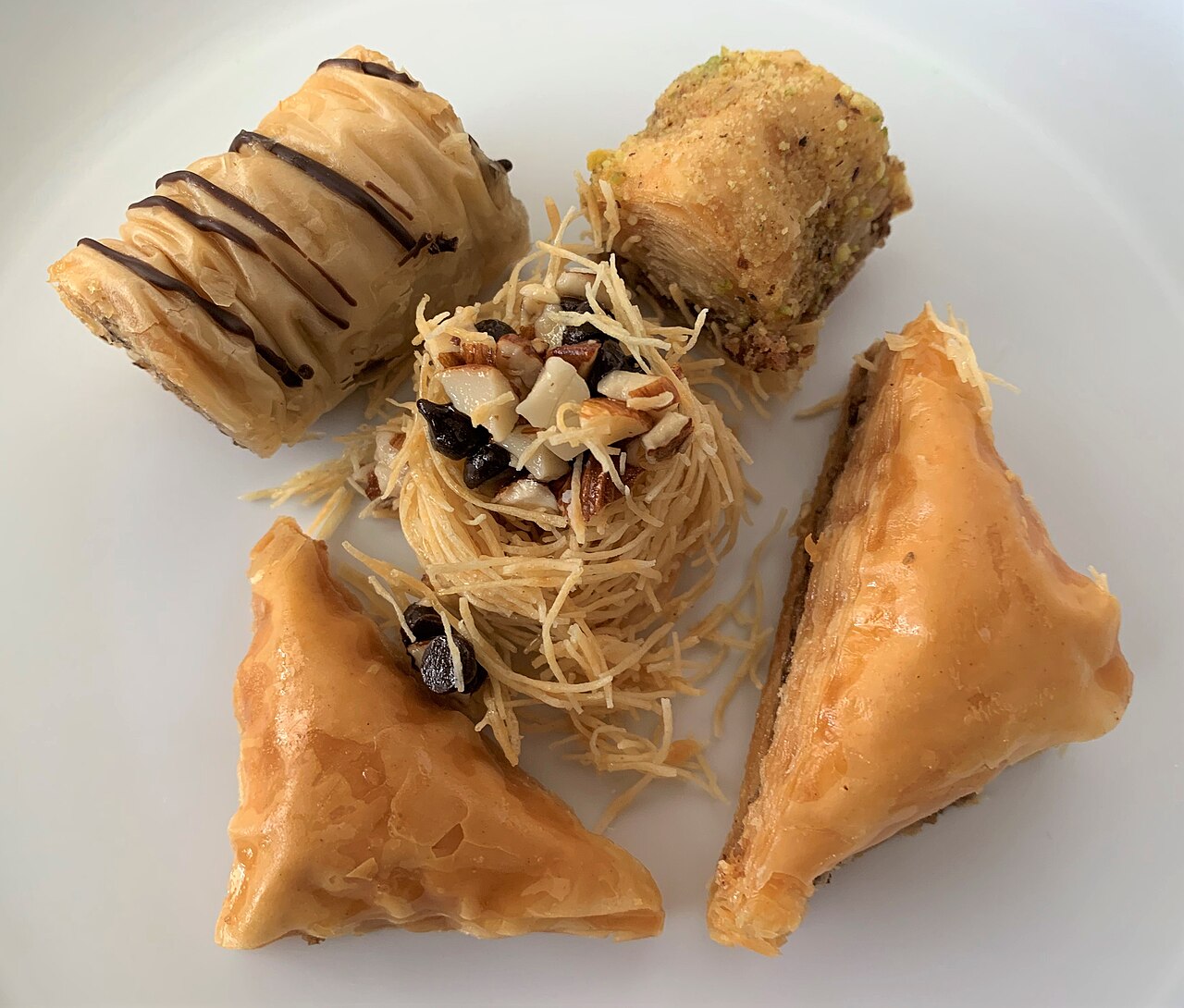
Baklava, several shapes. Photo: Chitrapa, CC BY-SA 4.0.
Baklava
بقلاوة
The most exported of the group and the least specifically Syrian — but
Aleppo's version is distinct. Where Greek baklava leans on honey and
walnut, the Levantine version uses sugar syrup, clarified butter, and
pistachio, and the pastry is rolled thinner.
The technique is the point: dozens of sheets of filo, each brushed with
butter, layered over a nut filling, cut before baking so the syrup can
penetrate, then soaked after. The shredded-pastry variant in the photo
is a different construction entirely — spun dough coiled around nuts.
BaseFilo, samneh, nuts
SyrupSugar, lemon, rose water
MethodLayered, cut, baked, soaked
RegionalAleppo pistachio style
WhereAleppo — pistachio and sugar syrup, not honey and walnut
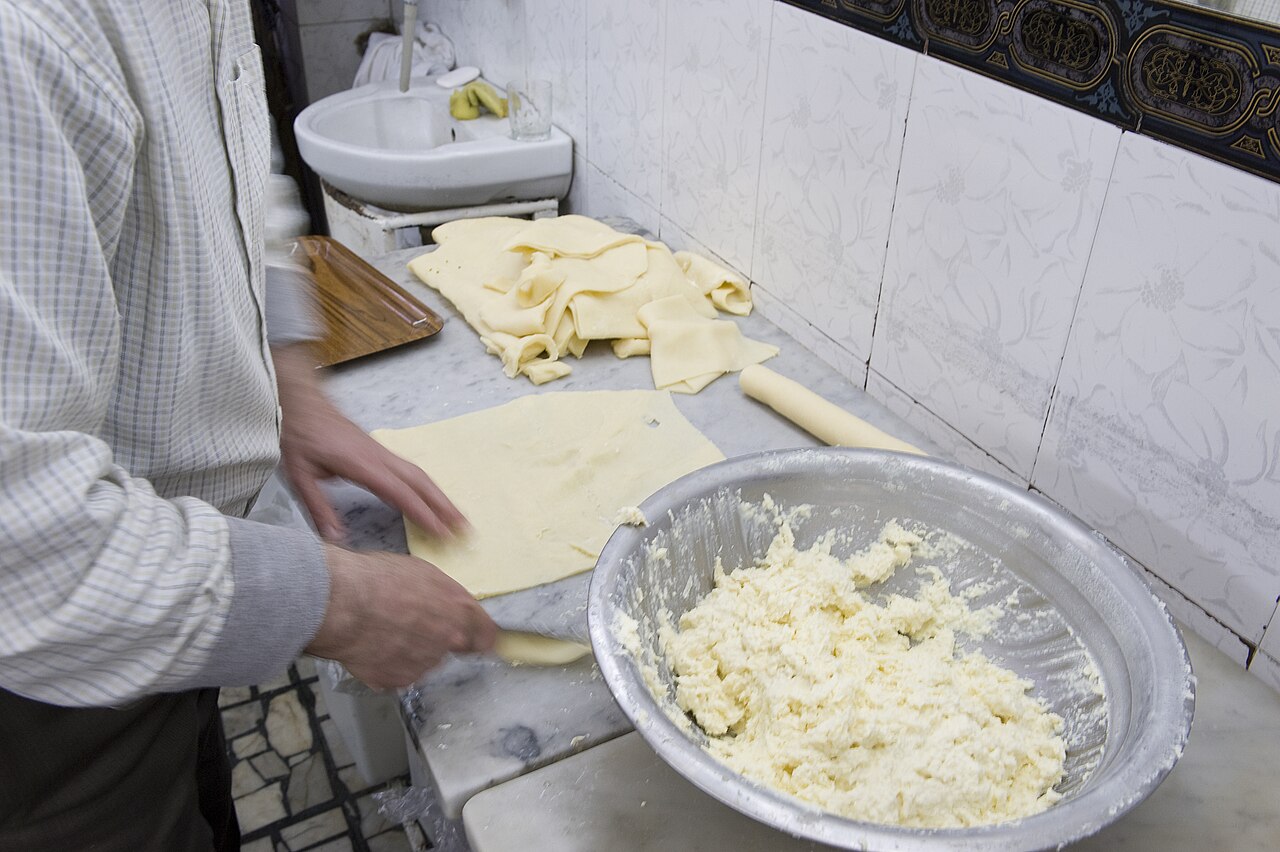
Halawet el-jibn being made in Hama. Photo: Dosseman, CC BY-SA 4.0.
Halawet el-jibn
حلاوة الجبن
A cheese dough — mozzarella or a mild akkawi — cooked with semolina
and sugar until it becomes elastic, then rolled thin, filled with
ashta (clotted cream), rolled into cylinders, and drenched in
syrup. The texture is the whole point: it should stretch before it
yields.
Hama is the city most associated with it, and the photograph above was
taken in a Hama workshop. It is a fresh sweet, sold by weight and eaten
the same day, which is why it rarely travels.
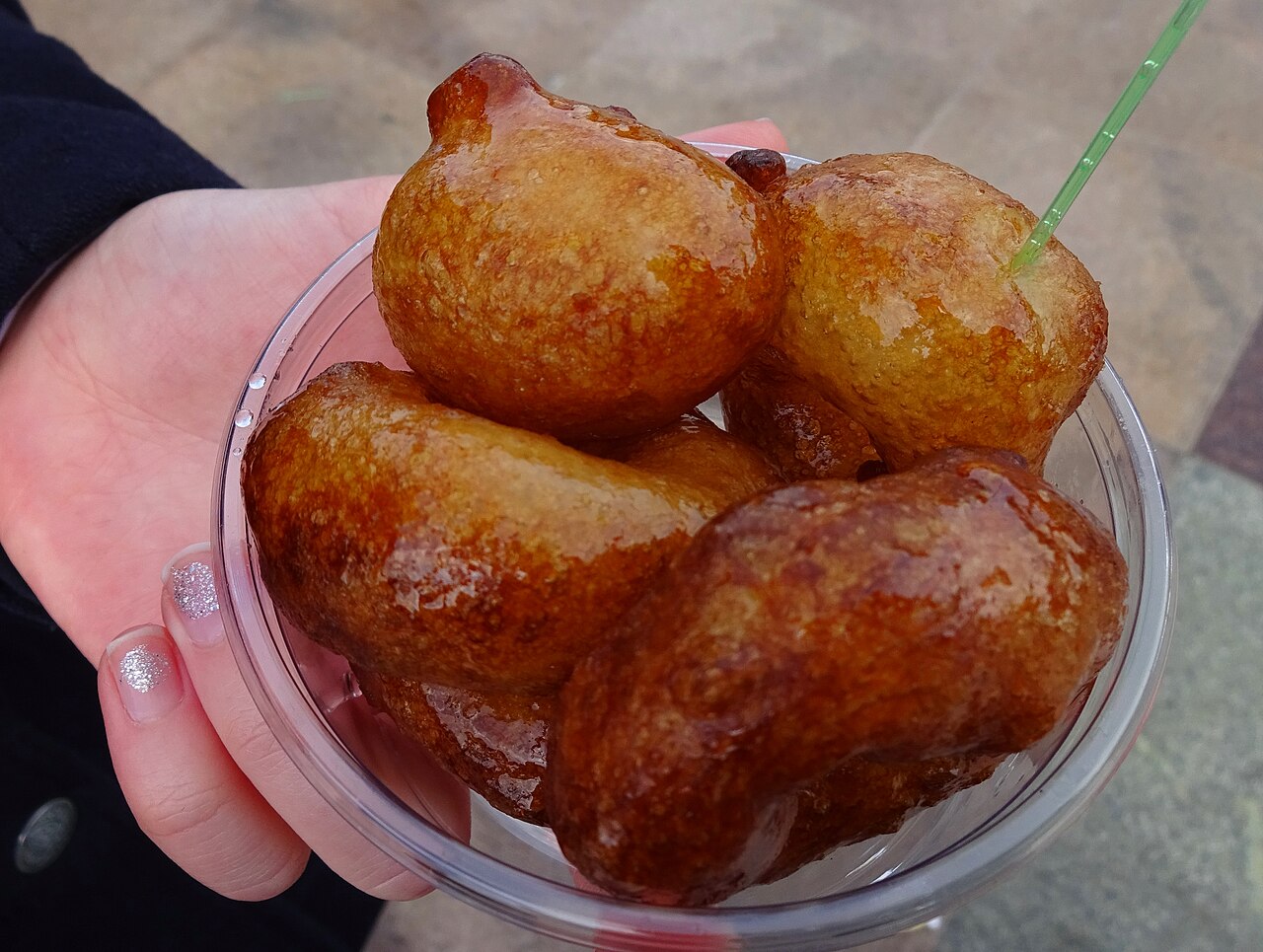
Yeast-leavened batter dropped into hot oil, fried to a dark gold, then
plunged into cold syrup so the shell stays crisp. Known across the
region as luqmat al-qadi — "the judge's morsels" — a name
recorded by al-Baghdadi in the 13th century.
The Turkish lokma and the Greek loukoumádes are the
same sweet under different names, all descending from the Arabic
luqma, a morsel. In Syria it is street food, fried to order.
BaseYeasted batter, oil
FinishCold syrup, sometimes cinnamon
MethodDeep-fried, then soaked
WhereDamascus and Aleppo street stalls
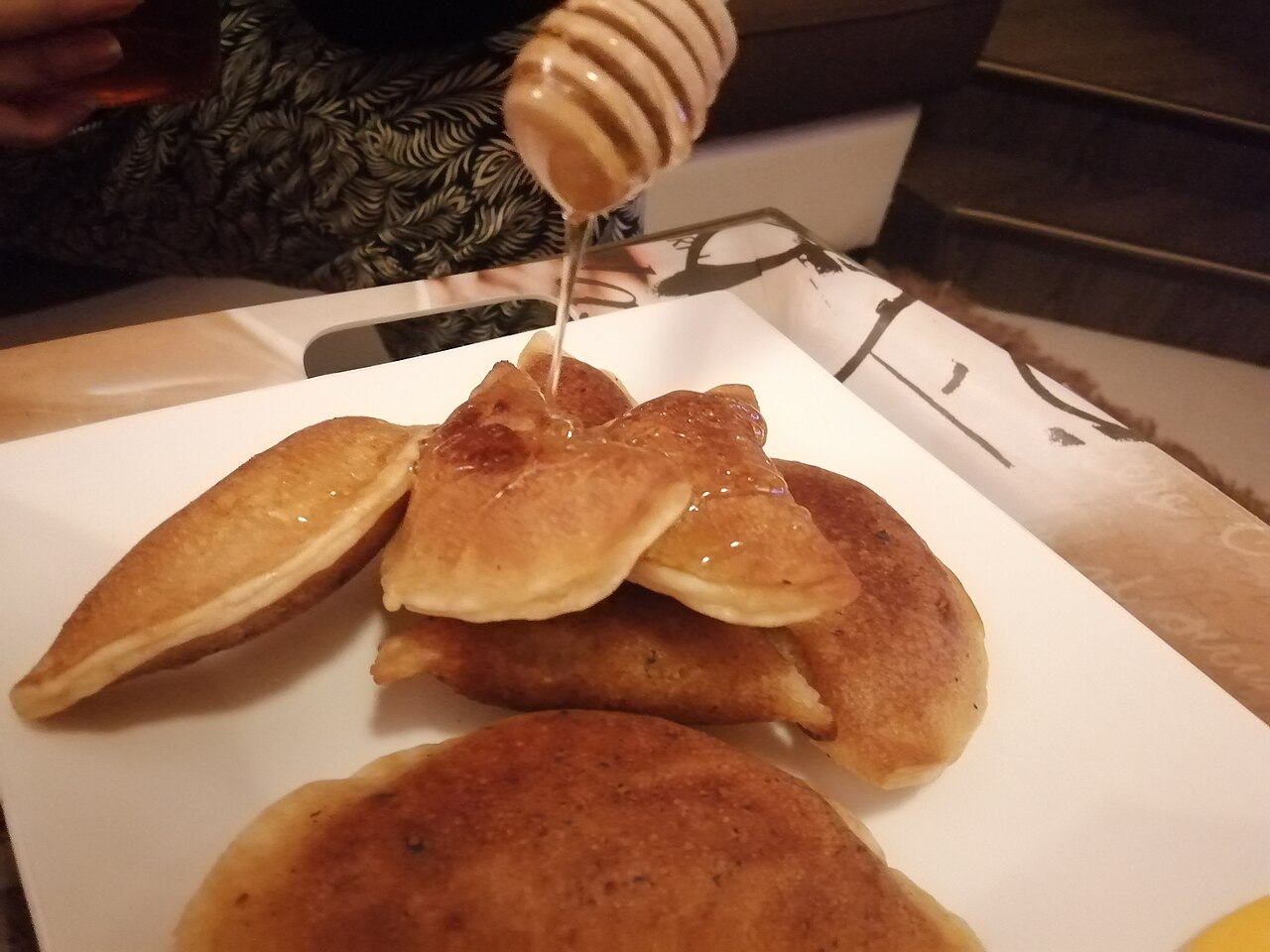
Qatayef with honey. Photo: Freedom's Falcon, CC BY-SA 4.0.
Qatayef
قطايف
A pancake cooked on one side only, so the uncooked face stays porous
and can be sealed. Stuffed with cheese or nuts, folded into a
half-moon, then fried or baked and soaked in syrup.
It is the most strictly seasonal sweet in the repertoire: in Syria,
Jordan and Egypt it appears almost exclusively during Ramadan. The
name comes from the root q-ṭ-f, to pick up or pluck, and the
dish is recorded in Ibn Sayyar al-Warraq's 10th-century
Kitab al-Ṭabīḫ.
BaseBatter, cooked one side
FillingCheese, walnut, ashta
MethodFolded, fried or baked, syruped
WhereDamascus — a Ramadan fixture
A sweet vendor in Nablus. Photo: Mounir.Kleibo, CC BY-SA 4.0.
Tamriyeh
تمرية
A semolina pudding — often flavoured with mastic — wrapped in very thin
dough, fried, and finished with pistachio and syrup. The name means
"made with dates", though most versions contain none; the reason for
the name is not recorded.
Homs is one of the four cities named in the literature as a home of
tamriyeh, alongside Nablus, Sidon and Port Said. Its origin is
genuinely disputed: Nablus is the usual claim, but some Nablus vendors
point instead to the village of Tamra.
BaseSemolina pudding, thin dough
FlavourMastic, pistachio
MethodWrapped, fried, syruped
WhereHoms — one of four claimed homes
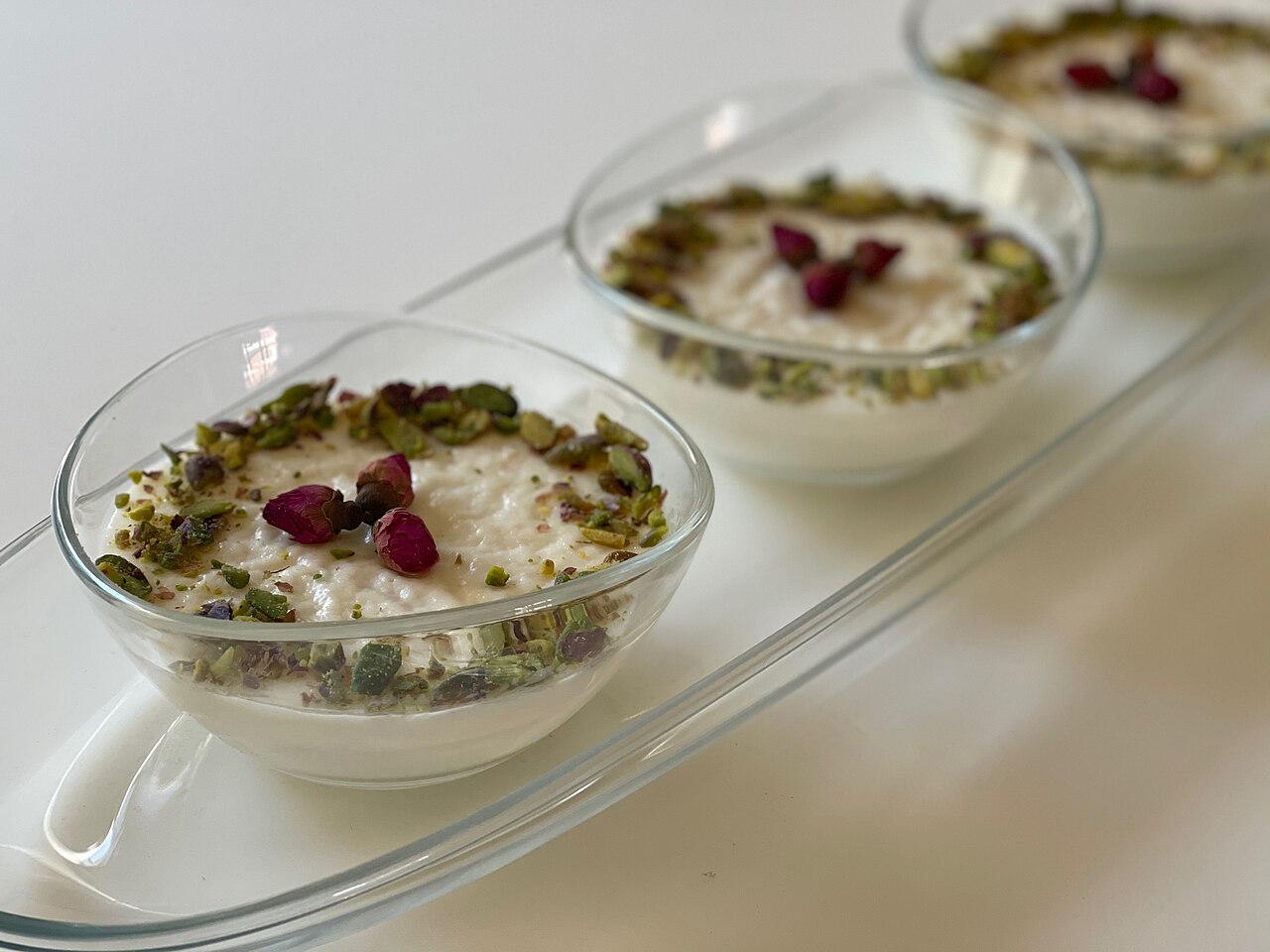
Muhallebi with pistachio and rose. Photo: Jktab, CC BY-SA 4.0.
Muhallebi
مهلبية
A milk pudding thickened with rice flour, cornstarch or semolina, set
in bowls and finished with pistachio, rose petals, or a spoon of
syrup. The lightest thing in the repertoire, and the one most often
eaten at the end of a heavy meal.
Legend has it that a Persian cook served it to the Arab general
al-Muhallab ibn Abi Sufra in the late 7th century, and that the general
liked it enough to give it his name. The earliest written recipes are
10th-century, and include a version thickened with ground rice and
another enriched with chicken.
BaseMilk, rice flour or semolina
FlavourRose, mastic, orange blossom
MethodCooked, set in bowls
WhereDamascus — sold from sweet shops and carts
Sfouf, coloured by turmeric. Photo: DocteurCosmos, CC BY-SA 3.0.
Sfouf
صفوف
A semolina cake coloured and lightly flavoured with turmeric, with
aniseed, sesame paste and pine nuts. Unlike basbousa it is not soaked
in syrup — the sweetness is baked in, which makes it a cake rather
than a confection.
The name means "rows", for the way it is scored before baking. It is
more strongly associated with Lebanon than with Syria, but it appears
in Syrian sweet shops and belongs to the same semolina family as
basbousa and maamoul.
BaseSemolina, tahini, turmeric
FlavourAniseed, pine nut
MethodScored, baked — no syrup
WhereLevantine; common in Syrian shops
03Where to buy
A short list of places that are documented rather than merely
recommended. Where a shop is famous enough to have a written record, it is
here; where it is not, it is not.
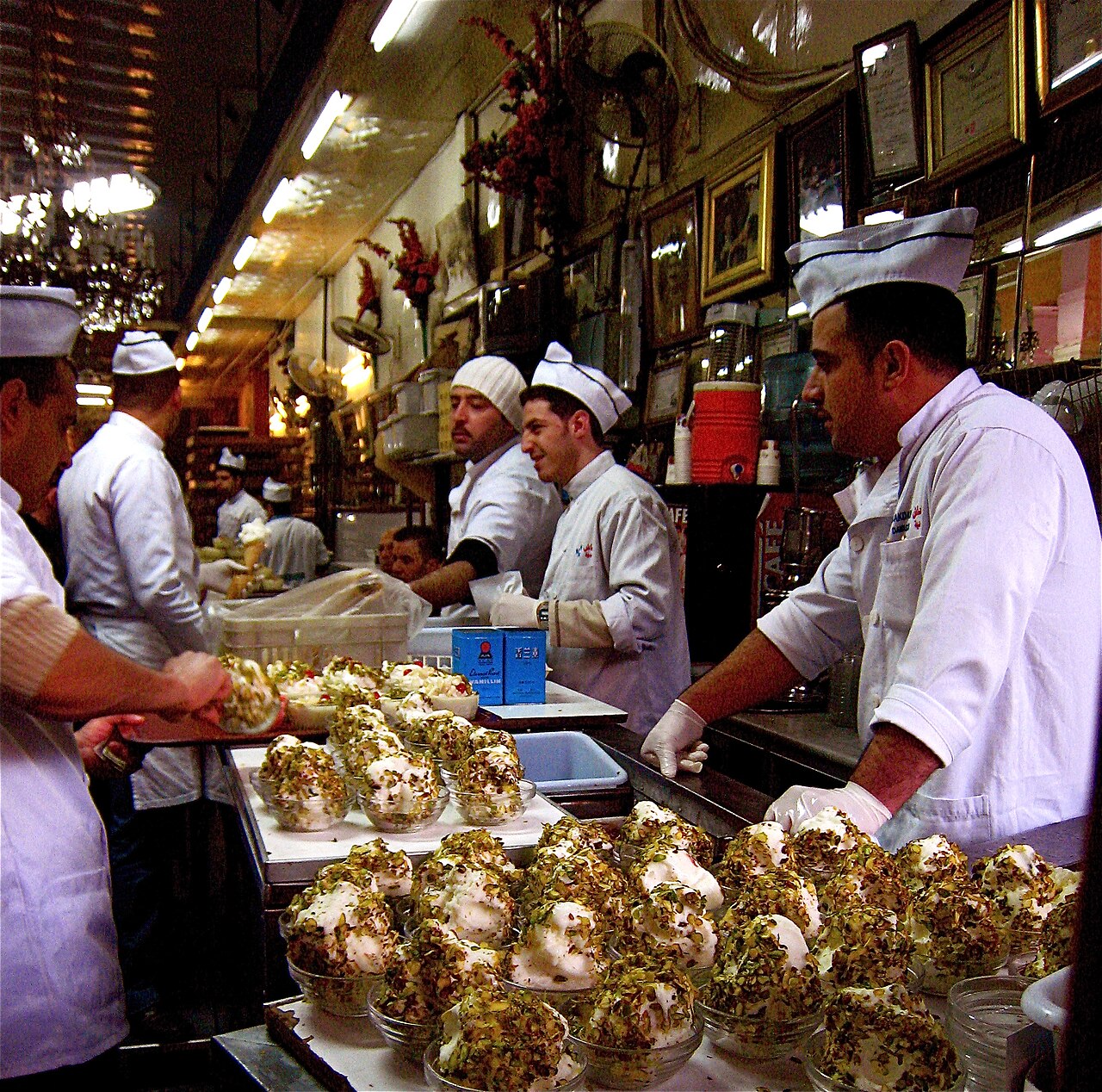
Bakdash, Al-Hamidiyah Souq, Damascus. Photo: Bakdash.JPG derivative, CC BY 3.0.
Bakdash
An ice cream parlour in the Al-Hamidiyah Souq in the old city of
Damascus, established in 1885. It sells booza — a mastic-thickened
frozen dairy dessert pounded with a wooden mallet rather than churned,
which gives it its characteristic stretch — rolled in crushed
pistachio.
It is the one entry on this page that is a landmark rather than a
recommendation: it appears in travel writing, in NPR and Saveur
reporting on the Syrian diaspora, and in Lucy Malouf and Anthony
Bourdain's Saha. Branches opened in neighbouring countries
during the war, some with the founders' permission and some without.
Beyond individual shops, the trade is organised by market. Al-Hamidiyah
in Damascus and the covered souqs of Aleppo's old city are where the
sweets are concentrated — the same geography that produced barazek in
Al-Midan and baklava in Aleppo still determines where you go to buy
them.
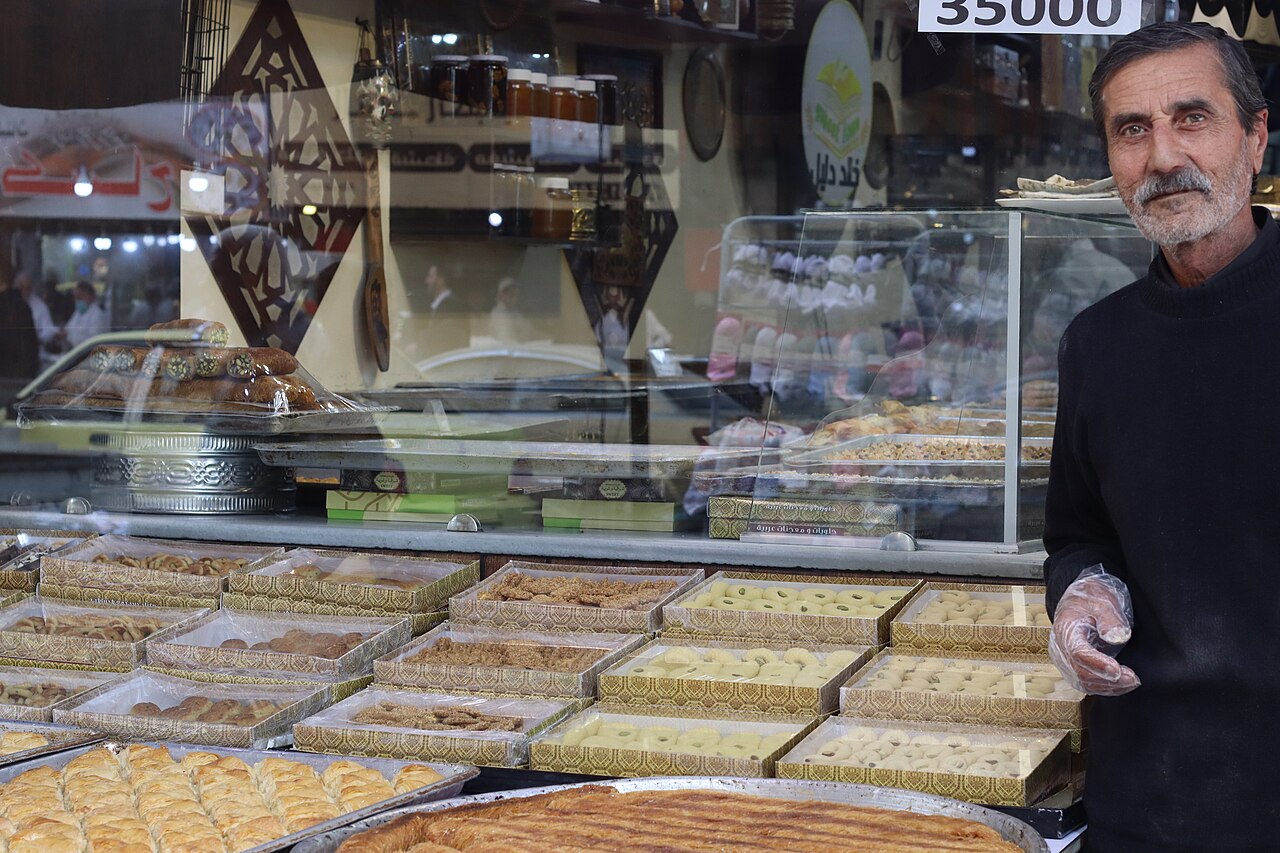
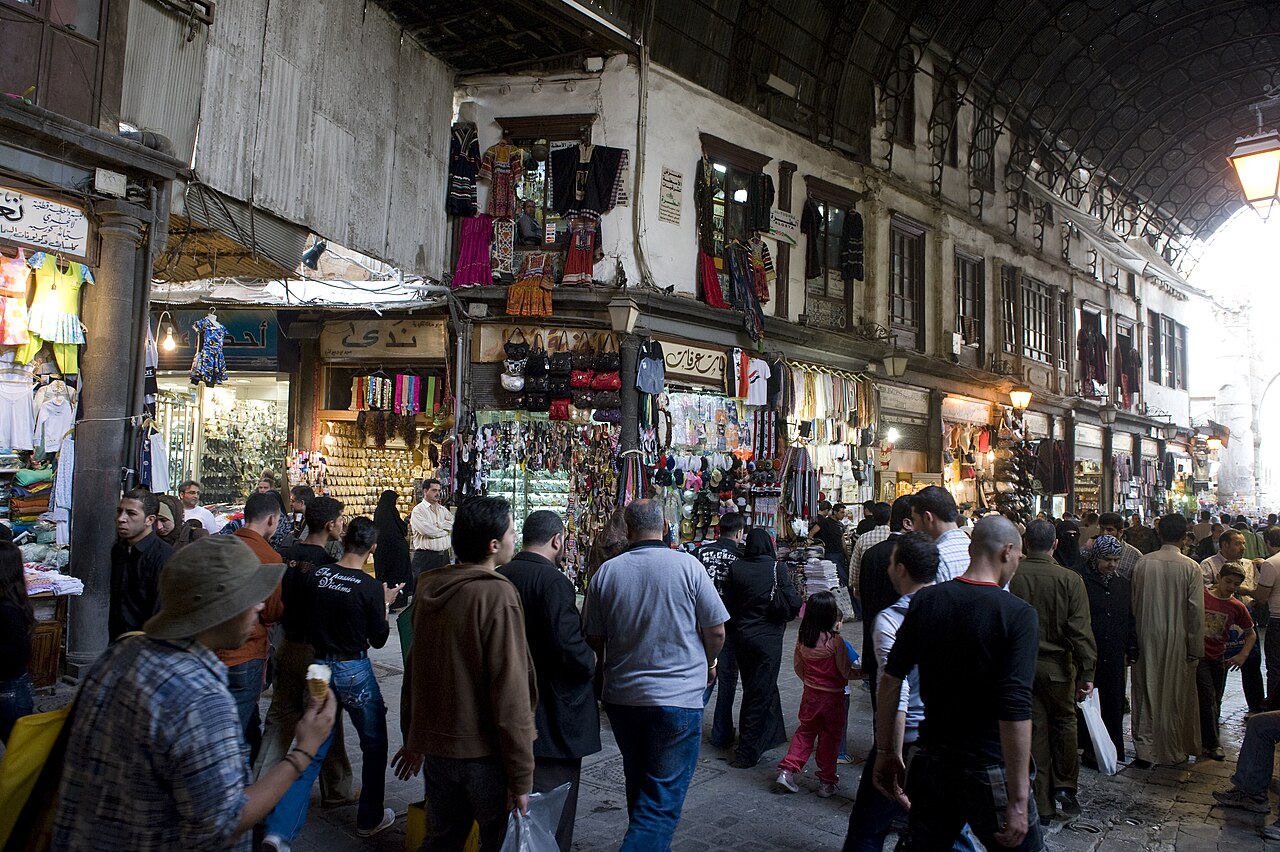
In Aleppo the sweet shops cluster around the citadel and the
Jdeydeh quarter. In Damascus, the sweet sellers sit alongside the
spice and textile merchants in the Hamidiyah arcade, which is why the
photograph above is a reasonable proxy for the whole trade.
DamascusAl-Hamidiyah Souq, Al-Midan
AleppoOld city, around the citadel
HomsLocal sweet shops, less exported
AbroadDiaspora shops in Amman, Beirut, Montreal
On this list. Only Bakdash is documented well enough to
name with confidence. Naming individual pastry shops in Aleppo or Homs
would mean asserting something about businesses I cannot verify, and a
guide that invents shop names is worse than one that admits the gap. If
you know the shops, they belong here.
04Technique
Almost everything in this repertoire is one of four constructions. Once
you can name the construction, the recipe stops being a list of
ingredients and becomes a method.
The four constructions, and what each one demands
Construction
What it is
The hard part
Examples
Semolina dough
Coarse semolina hydrated with butter or yogurt, then baked or moulded
Resting the dough long enough for the semolina to absorb the fat
Maamoul, basbousa, ghraybeh
Layered filo
Many thin sheets, each brushed with clarified butter, over a nut layer
Cutting before baking so syrup reaches every layer
Baklava
Spun pastry
Kadayif — dough drawn into fine threads — layered with cheese or nuts
Getting the cheese to melt without the pastry going soggy
Kanafeh
Syrup-bound
Hot sugar syrup worked into a fat or a seed paste until it sets
Temperature: too cool and it will not bind, too hot and it seizes
Halva, barazek glaze
The ingredients that do the work
Semolina is the backbone of the dough-based sweets. Its
coarse grind gives basbousa and maamoul their characteristic grain, and it
absorbs fat slowly, which is why the dough rests.
Clarified butter — samneh — carries flavour and
controls shelf life. Its absence of milk solids means it does not burn at
the temperatures filo work requires.
Sugar syrup is the preservative as much as the sweetener.
A saturated syrup poured over a baked pastry both sweetens it and seals
it, which is why so many of these sweets travel well.
Pistachio is the signature nut of the Aleppo repertoire,
and sesame the signature seed of the Damascus one. The
split is not absolute, but it is a useful way to read a pastry counter.
Rose water and orange blossom water appear throughout,
usually in the syrup rather than the dough, and usually in small enough
quantities to read as perfume rather than flavour.
05History
The written record of these sweets is older than the names they now carry.
The cookbooks
The 10th-century Baghdad cookbook Kitab al-Tabikh is the earliest
surviving Arabic recipe collection, and it already contains a shortbread
close to ghraybeh — khushkanānaj gharīb — as well as the first
proper halva recipes. A 13th-century collection from Aleppo, the
Kitab al-Wuslah ila l-habib, records the city's kitchen in
detail. A 14th-century Egyptian collection describes a cookie called
nuhūd al-ʿadhārī — "the virgin's breasts", for its shape — made
from equal parts samneh, sugar and flour.
The Ottoman layer
Many of the sweets now thought of as Syrian took their present form under
Ottoman rule. Barazek is dated to that period in Damascus. Baklava's
layered construction spread from the imperial kitchens outward. The
vocabulary shifted too: revani, kadayif, and
helva are Ottoman Turkish forms of words that had earlier Arabic
and Persian lives.
The modern trade
By the late 19th century these sweets were a documented industry with
named trades, guild-like specialisations, and their own literature. The
1889 Congress of Orientalists described Syrian ghraybe and Egyptian
ghurayba side by side. Zafir al-Qasimi's dictionary of Damascene trades
recorded the barazek seller as a profession. And in 1910, a pastry counter
in Manhattan's Little Syria was photographed serving the same repertoire
to an emigrant community — the first appearance of these sweets in the
American record.
What this page does not claim. The origin stories above
are the ones in the standard references, and several of them are
contested — kanafeh's in particular. Where the sources disagree, the page
reports the disagreement rather than resolving it.
06Credits and sources
All photographs are from Wikimedia Commons under the licences shown. The
text draws on the reference literature listed below.